Matt & Crista Vance (Hosts): Welcome everyone to today’s episode on the culture profit. We’re so excited to have an experienced chief people officer joining us from California to talk all about how to navigate change and some great tips for being an excellent leader in the workplace. So, we’re excited to welcome Oxana Lucish. Thanks for joining us today.
Oksana Lukash (Guest): Thank you, Matt, so much for having
Matt & Crista Vance (Hosts): Yeah, Oxana, she has such a wealth of information to share with us today and a cool background,
Oksana Lukash (Guest): me.
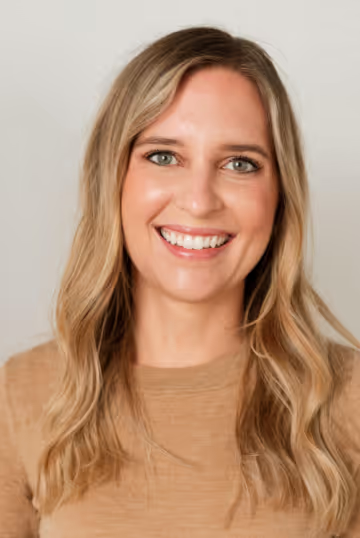
Matt & Crista Vance (Hosts): too. So, Oxana Lucish immigrated from Moscow to the US at age 13, which taught her early how to lead through change and build belonging from the ground up. Over the last 25 years, she has served as a chief people officer, adviser, and coach, building people strategies in high growth startups, Fortune 500s, and mission-driven organizations. She has led companies through hypergrowth, turnarounds, layoffs, leadership crises, and cultural rewrites. She helps leaders lean into their values and turn complex challenges into simple, simple, actionable insight.
Matt & Crista Vance (Hosts): If your listeners are navigating change, leading teams, or building a meaningful career or culture, Oxana will bring them truth, tools, and tangible steps they can act on right away. So, just a little bit about that. Oxana has been on podcast before. She’s not new to this. She’s also going to be giving her first TEDex talk. So, super cool. Make sure to follow her and and check that out. So, and tell us a little bit more about yourself and what’s what’s led you to this point,
Oksana Lukash (Guest): Yeah, thank you so much, Christa. Um, oh, I wish right I when I was little I had a road map.
Matt & Crista Vance (Hosts): Oxana.
Oksana Lukash (Guest): I think all of it was just being put in different situations, learning very early to trust my guts, and figuring out a path forward. I touch on it actually a little bit in my TEDex that we all do have choices regardless of what situation that we’re in. Um, and a lot of times, I think, unbeknownst to me, my choice was always to move forward and try to figure something out.
Oksana Lukash (Guest): And that has served me fairly well. Um, I learned to rely on my gut and be able to again try to assess a situation to my best ability. And something that also I made sure to share with my daughter as she was also growing up.
Matt & Crista Vance (Hosts): And how old is your daughter right now?
Oksana Lukash (Guest): She’s 24.
Matt & Crista Vance (Hosts): That’s right. So, you’ve been able to incorporate just that mindset of of always progressing, taking that next step, having a positive attitude despite any challenges and roadblocks that you’ve come across. and that has just helped you take those steps forward to being a chief people officer and now you’re doing your own thing. Tell us a little bit about culture people.
Oksana Lukash (Guest): Yeah, Christa, I wish I could say, right, I also had a positive attitude the entire time.
Matt & Crista Vance (Hosts): You
Oksana Lukash (Guest): I think that would definitely not be a fair statement. Um, it’s more I’ve learned to go back and revisit situations, events, and really be able to maybe look through them through a different lens or also look through them now with having more knowledge of where I am right now.
Oksana Lukash (Guest): I think we tend to do anything painful, anything uncomfortable, we tend to remember it that way. And of course, it was. And at the same time when we reflect of where we are right now most of the time we would not be here without that event taking place. So that really helped me also reframe a lot of the past hurts a lot of the past why me or why did this happen because now I see what it led me to. So when I’m in similar situations going through it real time, my actual take on it is a little bit different because I’m trying to focus more on where it’s going to lead me which helps the understanding and the healing process. Um in terms of my company people culture you honestly was a complete accident. Um um ever since I was in the deep operations um role and function, a lot of people still call it human resources. I don’t because I don’t look at individuals as resources or ever want to treat them that way. I’ve made sure to build a community around me.
Oksana Lukash (Guest): I started this function when I was 18-19 so very very young and I was very intimidated by everybody else around me. They had so much more knowledge. They had so many years of experience. They had degrees. They worked for huge companies. So I felt like right, what do I know? But on the other hand, by building relationships with them, really becoming friends with them, I build this amazing community that anytime I was faced with a new challenge, a project, something that I had to do, and I didn’t even know where to start, I could reach out to somebody and ask for advice or ask them to point me in the right direction or introduce me to somebody else. So, fast forward, some of that community Apologies if you heard the barking.
Matt & Crista Vance (Hosts): We all We all love our our dogs and
Oksana Lukash (Guest): I have three. So anytime something’s outside,
Matt & Crista Vance (Hosts): cats.
Oksana Lukash (Guest): So apologies for that. Uh but with people’s culture you it’s people started approaching me and just asking, hey, we have this, you know, situation here or quick project here.
Oksana Lukash (Guest): Is that something potentially you might be able to help us? And I love my work. So I would say yes and then it led to waiting. How much do you charge for this work? And that was a pause for me and I’m like what do you mean how much do I charge? I can make money doing this. Okay. And then fast forward to one of the companies that is so near and dear to my heart. I was employee number 17 there. Right. Build it from the ground up from the people operations standpoint. Unfortunately, we hit some very difficult financial times and um I was being impacted by a layoff and there was a potential opportunity to do consulting with that company after I left. So, I decided to stand up and incorporate my company. That did not pan out.
Matt & Crista Vance (Hosts): Cool.
Oksana Lukash (Guest): But then some other things have and also as we discussed in our uh in our conversation prior to starting to record I’m in California and in California it is becoming more and more difficult to be a consultant without being associated with an actual entity.
Oksana Lukash (Guest): So I did it more on a proactive basis. So as I step into doing more podcast, doing some speaking engagements, any other work that might end up, you know, finding me or I find it, it’s just again easier to do it with an LLC. But the timing worked out perfectly that when I needed it the most, some of the projects came through and I had the infrastructure to be able to support that and partner with the companies that needed me.
Matt & Crista Vance (Hosts): That’s amazing. Well, you definitely have done a lot of really cool things and I was looking at your LinkedIn and something that really stood out to me is um you have this statement, I step into companies when the stakes are high and the margins for error are low. And I was curious because I’ve definitely seen situations where there’s leadership change as being one of those. Um, you know, it’s a time to navigate how the market perceives the leadership as well as the employees. So maybe talk to us a little bit about that type of situation.
Matt & Crista Vance (Hosts): How do you help a company navigate those high stakes moments?
Oksana Lukash (Guest): Yeah, there are so many different definitions for highstake moments. It could be, to your point, Matt, a change in leadership. It could be where the company is getting ready to get a product approved by the FDA. Again, coming from, right, the pharma, life sciences, biotech world. It could be a situation again where in preparation that they know let’s say the product is about six months out from being approved and the company now needs a commercial team and if you think about life sciences or let’s talk about pharma you go from having what they call right the general administrative functions to now having to hire a commercial team that becomes twothirds of your employee population. That’s the growth that happens overnight. And depending on your product, it’s not just finding super experienced uh professional pharma sales reps. Most of the time they need to have specific experience in the area that your product is going to be right treating patients and you’re really bringing in individuals for them as we still used to call it back in the day right their rolodex.
Oksana Lukash (Guest): It’s their relationship. It’s their ability to already have relationships with the correct doctors. So the moment that product is in their bag, they can walk into the doctor’s practices and start talking about this new solution. So yes, moments of crisis where again those uh short time projects are fantastic. I also very much enjoy coming in before that. And the reason I say that is that’s where you can appropriately build the foundation. You can absolutely put in all the right amount of thought. You’re able to test or retest and work out as many kinks as you can from even let’s say the applicant tracking system. Because going back to the example of commercializing a product, if now you’re a company of let’s say 100 employees and you’re hiring a commercial team of 100, 150, that is a lot. That is not the time to test out your applicant tracking
Matt & Crista Vance (Hosts): Yeah.
Oksana Lukash (Guest): system to make sure it’s able right to schedule um interviews properly, that it has all the proper communication,
Matt & Crista Vance (Hosts): Heat.
Oksana Lukash (Guest): that all the paperwork related to different states is correct, that the entire flow of onboarding is working. You need to have worked that out beforehand. You need to already have the commission plans built out for the team because that is a big question that the sales right leaders or the sales reps are going to be asking about because that’s a big part of how they’re compensated. It’s figuring things out like are you going to have a car allowance or are you going to provide an actual company car? All of that needs to be in place plus all the other nuances, right? What does your equity plan look like? When are you planning to launch uh the product? Is your equity only when somebody starts? Do you have refresher equity grants? Do you do them annually? Do you do them again for potentially achieving big milestones? All of that needs to be discussed and be in place. But that means my function, my role, and everybody else in the organization.
Oksana Lukash (Guest): We need to put our experience, our minds together, think through as many whatifs, think through as many experiences that we’ve had in our past lives of things that have come up, right? discuss them, align on what we want that path forward to be and then come up with uh we as an organization are going to answer that question or what are we going to have in place. So when the conversations are happening, it’s all right, good to go. So to give you an idea and usually the commercialization part does take place very very quickly and it depends on how the company wants to approach it. I’ve been in a situation where everything leading up to actual in-person interviews took about a month or so, but then the entire interview process to hire I believe it was 64 people total was 12 days back to back where myself and a few other
Matt & Crista Vance (Hosts): Oh yeah.
Oksana Lukash (Guest): leaders flew to I believe it was five or six different states right in 12 days. We had 12 to 14hour long interview days.
Oksana Lukash (Guest): And we were making decisions automatically on yes, we’re going to hire this personnel and then be able to come back, take a step back, and not only look at the skill sets that each person was bringing to the table, but because we were hiring different groups that are going to write report to different managers, what skills do we now have holistically for each group? and then stepping back and saying, “Okay, we still have three openings. What are our gaps? What do we need to focus on and tweak in the conversations that we’re going to be having with the next set of candidates for these specific territories that we can also ensure not only do they right meet the requirements of the role, but they also have those other skill sets that are going to close some of the gaps on the team and make the team that much stronger. So that was a very long answer to your question.
Matt & Crista Vance (Hosts): No, I like that strategy of looking for gaps that need to be filled. I think that’s important rather than just, oh, so and so’s leaving the company, so let’s fill this role.
Matt & Crista Vance (Hosts): It’s what skills, what things do we need accomplished here, and how do we fill those with the right people? And just going back a little bit, I love you. I feel like you are so customizable. You’re able to adapt to what you’ve mentioned. It doesn’t matter what kind of company we’re talking about, all of them are so different. They have different values, different missions, different goals and different places that they are in their growth. And so no matter what point you’re coming in, you’re either ready to help them structure things from the ground up or you’re helping them with a CEO change. Um, what is maybe some advice that you could give to a leader who’s in a role to help with changes like this? Maybe a people role or HR, something along those lines. What’s some advice that you could give them that maybe could be applicable no matter what organization they are? I know we have a pretty broad audience. To me, the first thing I see is that you are able to ask the right questions and that that helps you pivot and move forward.
Matt & Crista Vance (Hosts): Do you have any other thoughts of how what advice you could give
Oksana Lukash (Guest): Yeah, that’s a great question. Um,
Matt & Crista Vance (Hosts): them?
Oksana Lukash (Guest): my advice to any leader at any level within the organization would be stay curious. I notice the higher you go, the more it becomes about not you having the answers, but about asking questions to build the relationship with whoever, right, you’re working with with all of the stakeholders of your organization. So that way you have the information that you need or and information that you need might be who you also need to be talking to within your company on a specific topic issue initiative that you have so that way you have as much as you need from the content standpoint. an example. We’ve gotten stuck making decisions at the board level, at the executive level, and we just continue doing that. But most of the decisions that are made at the board level and the executive level really impact the people that are doing the job of our business on the floor.
Oksana Lukash (Guest): And the big gap, and this is not a knock on anybody or being right spicy in any way, but most of us have either never done that job or have done that job 15, 20, 30 years ago. Let’s even step back and take a look at how we even live dayto-day. What are we doing today and compare that to a year ago? Then let’s take that with our roles and see what has changed in a year. So the reason I say that is we continue making all of the very important decisions in a vacuum without inviting individuals that are going to be impacted by it the most. And I completely understand the confidentiality. I understand being part of public companies. I understand being part of again very highly regulated organizations. I’m not saying go ahead and ignore it, but there’s still a way to bring in individuals as it makes sense. And there are also other things in place, NDAs, right? You can bring somebody under the cone of silence and then bring in other individuals as it’s appropriate, but you’re getting their take and their understanding of what it actually is to do that role.
Oksana Lukash (Guest): So, curiosity would be one. And also, we live in a world where you have to be a forever learner. I was just wired that way and I’ve lived my life that way and don’t know any other way to function. But I’ve worked with so many leaders that flat out have said I wouldn’t have gotten here right where I did if I didn’t know everything I needed to know. So obviously if I’m here I’m good. I don’t need to know anything. I’ve heard leaders say too this is my last role and I’m retiring in an x amount of years. if it’s not broken, not for me to fix, right? Somebody else can worry about it and everything else in between you can think of. That doesn’t apply anymore. Because another thing is we truly don’t realize as leaders how many eyes are on us. And it’s more what we do, not what we say that the rest of the organization is paying attention to. So if we are again not curious, if we’re judgmental, if we’re still applying frameworks and playbooks from 20, 30 years ago that also have language where you’re like, oh my goodness, right?
Oksana Lukash (Guest): How much training do we need to do now companywide to minimize the risk of everything that was just said from this playbook? Employ like the team members see it. So why do they want or have any incentive to do anything different unless they’re wired that way unless they’re driven in a different capacity and lots of people are. But those are also tend to be the individuals that are going to get those skills for themselves as they still should and leave because they’re going to outgrow the environment that now is trying to keep them small versus creating that environment of learning and growing and truly being together as a team. Because if if leaders do not see that what you do, the services you provide, the products that you have, go online, use a few different AI agents, give them good enough prompts to find out everything that right is great with your product, all the or service, all the areas of opportunities, why customers work with you, why customers have left. Somebody has a blueprint of how to copy your company with all of the areas of opportunity so they can copy your company and address all the issues that you have.
Oksana Lukash (Guest): What they’re going to have a much harder time doing, and of course that was a very simplified version. What they’re going to have a much harder time doing is taking your talent. If you are authentic, intentional, and thoughtful about the experience you create for your talent, that’s worthy of them, that is so difficult to replicate, let alone make better. If you are a company that says one thing and you have nice words on the walls, in an employee handbook, wherever else, but what is actually happening every single day is different, your talent will jump at the first opportunity that they get. And the world that we live in, I think the true competitive advantage of any organization is the talent. So the companies that have been focusing on that are right as long as they continue doing that I think are going to do great. The companies that have not and usually they’re the ones we hear in the news are not right and on read about online not for good reasons. I think are very much going to struggle and I think with a lot of them we might not see them around in the
Matt & Crista Vance (Hosts): Yeah. No, that’s so true.
Oksana Lukash (Guest): future.
Matt & Crista Vance (Hosts): And I love what you’re saying about that connection between leaders and individuals. And I think that’s key to why you need to have systems in place to help for a CEO change because suddenly you’ve severed that connection. There’s a different leader that isn’t aware of what the individuals feel and say. And so those connections, everything you just said is probably the exact same process you go through to help a company with a crisis change like this where they try to reestablish those connections between the leader and the individuals. And so we our company is Mobriam and we you know I think it’s so good to get like individual voices and actually meet with them that personal touch but there’s also the touch of a survey where you’re getting the collective voice of all your employees and the leader needs to be aware and listening to that collective voice. so important following up, you know, having closing the feedback loop, whether it’s a survey, whether it’s focus groups, whether it’s interviews, like what you’re saying, bringing someone into the board to um talk about what it’s like to do a certain job.
Oksana Lukash (Guest): Right.
Matt & Crista Vance (Hosts): Probably a mix of all of them, right? Yeah. Yeah. And the public side with online reviews as well, which is, you know, what we focus on because that’s shaping perceptions and behaviors because everyone sees it. It’s not just, you know, the private conversation in the boardroom. Both are really important and I think your focus on you know staying curious and also being a leader or a learner lifelong learner is critically important for people leaders to be able to see all the info that’s around them to make these smart decisions when the stakes are high. Not someone that comes in here. I’m super professional. I know why I was hired and so whatever I’ve done at every other company is going to work great for this company. Right. Because just like you said, you have to be customizable. You have to listen to your people. You have to develop that new connection. And sorry, you were gonna No, that was it.
Matt & Crista Vance (Hosts): Yeah.
Oksana Lukash (Guest): Sorry, I was going to say it’s interesting you brought up the surveys
because I I think it was Saturday I made a post on
Matt & Crista Vance (Hosts): So
Oksana Lukash (Guest): LinkedIn about employee surveys, but the whole right and the caveat is don’t do it to check the box if that’s why you’re doing it.
Matt & Crista Vance (Hosts): yes.
Oksana Lukash (Guest): be also very mindful of the questions that you ask.
Matt & Crista Vance (Hosts): Yeah.
Oksana Lukash (Guest): I would rather again my personal practice do a few shorter surveys I call them pulse surveys throughout the year on a specific topic to make it first of all easy for employees to answer that it’s not going to be super time consuming and be able now to gather the
Matt & Crista Vance (Hosts): Great.
Oksana Lukash (Guest): data in AI oh my gosh right the biggest gift for survey analysis be able to analyze the data so quickly to come back with
Matt & Crista Vance (Hosts): Mhm.
Oksana Lukash (Guest): actual action The moment you do two or three surveys to check the box to discuss all the things you’re going to discuss again in the executive room at the board presented to your investors because again you want to look good but you have done nothing in the organization and there’s no communication or my favorite you’re communicating about it 6 to 12 months after the survey where it’s completely irrelevant.
Oksana Lukash (Guest): you’re lost to your people. They’re not going to answer those surveys or if they are,
Matt & Crista Vance (Hosts): Yeah.
Oksana Lukash (Guest): they’re completely not going to take it seriously. So, be mindful of why you’re doing it. You’re not doing it for all of the accolades. You’re doing it to be able to continue to have a pulse of what’s going on. And another huge thing that I’ve seen that folks I think miss is they get so consumed with focusing on the areas that need to be improved that they completely abandon all of the areas that they scored high in. And then the results from a similar survey down the road are complete
Matt & Crista Vance (Hosts): Mhm.
Oksana Lukash (Guest): disaster. And then they don’t understand why. It’s because you jumped so far in on the few areas that you might actually not be able to address that you’ve stopped doing all the things that actually matter to the employees. So it is that delicate balance of absolutely ensuring and again talking to your leaders, talking to the people leaders of these are all the areas you’re that you’re doing amazing that employees are loving.
Oksana Lukash (Guest): How can you continue doing that and do more of it? Here are the areas that we can do better in. So, right, how to start talking again to your teams about what is needed? Get their definition of it, not yours and then what are these areas that we might have potential issues
Matt & Crista Vance (Hosts): Mhm.
Oksana Lukash (Guest): in and is it truly an issue? Because sometimes it could be a miscommunication. Like I love doing these types of surveys on benefits, especially about six months or so prior to open enrollment to really understand what matters to our employees. How are they using the benefits? What do they want to see more of? What other programs do they just not care about? And then having those conversations with employees. A lot of times, guess what? We have exactly what they’re looking for. They just don’t understand it. So that’s an easy solution of just having again Matt like you said focus groups having lunch and learns sending additional information and being able to again advertise possibly right again the amazing benefits and perks the company already has that employees were too afraid to right ask a question about and you automatically address the area that you needed to.
Oksana Lukash (Guest): But again, it’s so nuanced and you have to care and you have to put um time and people behind it versus just, “Yep, survey done, moving on. We’ll do it again next
Matt & Crista Vance (Hosts): It’s almost worse to do a survey if you have no intention of actually taking any of
Oksana Lukash (Guest): year.
Matt & Crista Vance (Hosts): the feedback from it. Everything you said. Absolutely. And I love how we kind of started this episode more on the personal development side and just everything you’ve done that has helped you grow to where you are. And I think there’s so much we can learn from that. And then finishing on that leader’s side, having that connection from leader to individual, staying curious, all being a lifelong learner. All these things are so important. And for our listeners, please connect with Oxana on LinkedIn. Watch out for her TEDex talk that’s coming up. and such a great episode. That was awesome to have you on, Oxana. Thank you so much. Yeah, thanks for joining us
Oksana Lukash (Guest): Thank you,
Matt & Crista Vance (Hosts): today.
Oksana Lukash (Guest): Crista, Matt. It was my pleasure.